How long does it take for a Schengen Visa to be approved and How long is a Schengen Visa valid?

There is no fixed period, and it depends a great deal on several different factors. Hence it is advisable that the embassies be provided enough time for processing the visa. In some cases, it may take only a couple of weeks, while others have reported having to wait up to two months to get their visas.

During peak seasons, there are a lot of tourists visiting the Schengen countries, so the embassies are required to deal with tons of applications. These are some of the factors that one needs to take into consideration before applying. Also, the application is submitted should be complete so that any unwanted delays are avoided later.

How much does it cost to apply for a Schengen Visa?

The cost of applying for a Schengen Visa will depend entirely on the prevailing exchange rate between the local currency and Euros and is likely to change from time to time. It is also important to note that payments made for a visa are non-refundable. Usually, no fee is applicable for kids under the age of 6 years.

 Applicants should also inquire with the embassy if there are any additional charges that they need to pay. The payment is mostly taken in cash, and there is a reluctance among the embassy workers to provide change, so it is advisable to carry the exact amount while proceeding for the application.

How long is a Schengen Visa valid?

The validity of the Schengen Visa is for a maximum period of 90 days. Those planning to travel to multiple countries during the period or having intentions of traveling in and out of the Schengen Zone should remember to mark the “multiple entry” option in the application form. Applicants receiving approval for multiple entries are given a visa valid for six months, which means that they can travel in and out of the Schengen Zone for 90 days within a 6-month period.

WHAT COUNTRIES REQUIRED A SCHENGEN VISA TO VISIT THE SCHENGEN AREA?

If you are not one from one of the next 62 countries, you will need a Schengen visa: Albania, Andorra, Antigua and Barbuda, Argentina, Australia, Bahamas, Barbados, Bosnia and Herzegovina, Brazil, Brunei, Canada, Chile, Colombia, Costa Rica, Dominica, El Salvador, Georgia, Grenada, Guatemala, Honduras, Hong Kong, Israel, Japan, Kiribati, Macau, Malaysia, Marshall Islands, Mauritius, Mexico, Micronesia, Moldova, Montenegro, Nauru, New Zealand, Nicaragua, North Macedonia, Palau, Panama, Paraguay, Peru, Saint Kitts and Nevis, Saint Lucia, Saint Vincent and the Grenadines, Samoa, Serbia, Seychelles, Singapore, Solomon Islands, South Korea, Taiwan, Timor-Leste, Tonga, Trinidad and Tobago, Tuvalu, Ukraine, United Arab Emirates, United States of America, Uruguay, Vanuatu and Venezuela.

However, in 2021, the European visa situation will change. Travelers from certain countries will need an ETIAS (European Travel Information and Authorization System), while others will need a Schengen Visa. The whole situation can be rather complex and confusing, so to help you, below is an explanation of the Schengen Visa vs. the ETIAS.

SCHENGEN VISA VS. ETIAS

The Schengen Visa currently allows travelers who can’t visit Schengen countries without a visa to travel around Europe. This visa will continue to serve that purpose even after 2021.

On the other hand, the ETIAS is an electronic travel authorization designed to strengthen travel security in Europe (not only in the Schengen Area).

It is specifically geared toward citizens of the 62 countries mentioned above who do not currently need a visa to travel to and around Europe.

Starting in 2021, these travelers who can currently travel to Europe without a visa will need authorization in order to travel to Europe. This will be a big change for citizens of countries like the United States, who can currently travel to Europe without even having to worry about any kind of visa.

Basically, travelers who have always used the Schengen Visa to travel to Europe will still need a Schengen Visa after 2021. However, travelers from the 62 countries who, prior to 2021, never needed a visa to travel to Europe will, starting in 2021, need to obtain either ETIAS approval or a Schengen Visa. Travelers do not need both.

Note: Citizens of the U.K. will also need ETIAS to visit other countries in Europe if Brexit goes through in October 2019.

WHICH EUROPEAN COUNTRIES WILL REQUIRE ETIAS?

ETIAS doesn’t only apply to the Schengen area but to some other countries in Europe too. These are the European countries that will require ETIAS upon arrival: Austria, Belgium, Luxembourg, Netherlands, Germany, France, Spain, Portugal, Sweden, Finland, Denmark, Lithuania, Latvia, Estonia, Poland, Slovakia, Hungary, Slovenia, Italy, Greece, Czech Republic, Malta, Iceland, Liechtenstein, Norway, Switzerland, Monaco, San Marino, and Vatican City.

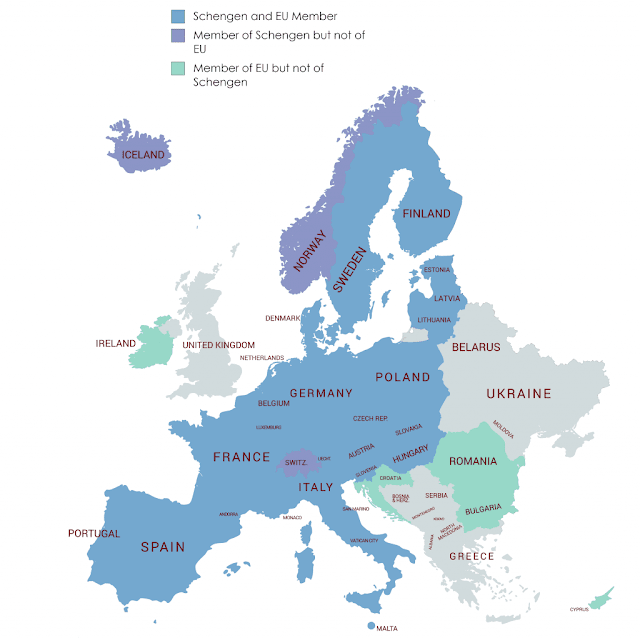
In the next map, you will see all the countries that require ETIAS. Some of them belong to the European Union, some of them to the Schengen Area but not the European Union and some of them to the European Union but not the Schengen area.

What is travel insurance For Schengen Visa and what are the requirements?

Whether you’re heading to snowy slopes or beautiful beaches, going abroad is an exciting experience.

Although accidents can happen while you’re away, the best travel insurance policies provide you with peace of mind; with travel insurance from Schengen Visa, you’ll be covered for many unforeseen costs incurred whilst you’re away.

Our holiday insurance can be used to cover medical expenses, trip cancellation, delays, lost or stolen baggage and personal liability. When you choose Allianz Assistance travel insurance for your trip, there’s no more wondering ‘what if?’.  There’s a policy for most types of travel so, whether you’re heading on a family holiday, a last-minute business trip or jetting off on a few city breaks, we’ve got you covered.

Below is some more information about our products, for which Terms and Conditions apply. Please visit the policy information hub for full details.

You spend months planning and looking forward to your holidays, and Schengen visa  travel insurance helps you to protect your investment. There’s no need to worry about whether medical emergencies or delayed flights will affect your trip, because we offer the support you need to handle the unexpected. Plus, with three different levels of cover to choose from, you’re sure to find the right travel insurance for you.

Choose the plan that suits you and you’ll be protected for your holiday. The type of travel insurance you need will depend on the countries you’re visiting, the activities you’ll be doing and the length of your trip. We offer Single Trip and Annual Multi-Trip travel insurance, and can provide cover for Backpackers (under 35) too. 

Schengen Visa Insurance requirements

When you apply for a visa to travel to Europe, you must submit a copy of your travel insurance policy along with your Schengen Visa form. If you fail to prove that you have existing insurance or if your minimum coverage is not enough, your request will automatically be rejected.

Before you purchase your medical insurance for Schengen Visa, you must choose one that meets the following criteria:

  •             A minimum coverage of €30,000. However, if you plan to take part in sports events or engage in similar activities, it is advisable to get some add-ons to be fully covered;
  •             The policy should cover all member states of the Schengen Area, or at the least the ones where you are allowed to travel.
  •             Your insurance must cover the entire period of your stay or transit in the Schengen Area;
  •             Your policy must cover several health expenses, such as repatriation for medical reasons.

If you are an EU or EEA national, you do not need a visa nor travel insurance to cross the Schengen Area borders. However, it is recommended to get health insurance to cover at least urgent medical issues.

Difference between Schengen Visa Validity and Duration of Stay

Aside of a multiple-entry visa, which enables you to remain in the Schengen area for a maximum of 90 days within a 180 days period, the validity of your single-entry visa or double-entry visa depends on the embassy. The embassy appoints the number of days you are permitted to stay in any of the Schengen countries, as well as the first date you are permitted to enter Schengen and the last day that you are permitted to remain.

This is the point where many people get confused, because they do not realize there is a difference between visa validity and the duration of stay in a visa.

Duration of Stay – is the maximum of days you are permitted to remain in the Schengen. The first day you enter Schengen is counted as “Day 1”, even if you enter just a few minutes before midnight. Whereas, the “Last Day” is counted the day you leave Schengen, even if it is just a few minutes after midnight.

Visa Validity – on the other hand, is the period of time from which to which you can use your visa to enter and stay in the Schengen Area.

Example: the duration of stay in your visa is 10 days, whereas the validity of your visa is from 1 January to 20 January. In this case, you can enter the Schengen Zone anytime within this period. You can enter i.e. on 3 January and leave on 12 January.  On the other hand, if you enter on 15 January, you will still have to leave on 20 January, despite of not having spent the number of days you were permitted to stay.

On the other case, if you have a double-entry visa, with a visa valid from January 1 to March 1, and a duration of stay of 10 days, then you can enter the Schengen Area twice within this period. You are still not allowed to remain more than 10 days during both trips. If during the first trip you stay 7 days, then in the second trip you can stay for three days at most. If you make just one trip and spend 10 days in any of the member states, then you have no right to enter the country despite of the fact that you visa is still valid.

As per a multiple-entry visa, if i.e. you have a three-year multiple-entry visa, which becomes valid on January 15, 2018 then you will be permitted to enter and leave the Schengen whenever you want until January 15, 2021. You should not forget that there is a rule of 90 days limit per each 180 day-period.

90/180 Schengen Visa Rule

Another point where most multiple-entry Schengen visa holders get confused, as well as the nationals of the countries that are permitted to enter Schengen visa-free. Most people think that the 180-day period starts on the day you visa becomes valid, which is not true.

Actually, the 180-day period keeps rolling. Therefore, anytime you wish to enter the Schengen, you just have to count backwards the last 180 days, and see if you have been present in the Schengen for more than 90 days throughout that period.

Check the Schengen visa calculator to calculate the remaining number of days that you can stay in the Schengen zone.

What are the additional and mandatory Requirements for Schengen Visa?

Documents Required for Schengen Visa

General/Mandatory Requirements

These are the general mandatory documents for travelling to any Schengen Zone:

1.         Passport: A valid passport with at least 3 months validity from the date of return from Schengen Area. Also, passport MUST not be older than 10 years, i.e. it must have been issued in the last 10 years. The old passport will also be required if you have any.

2.         Visa application form: Must be filled and signed.

3.         Photos: Two passport-sized similar photos. The photos must have been taken recently, like within the last 3 months.

4.         Round trip reservation or Itinerary: It must mention all hotel books, flights, flight numbers, dates, entry, and exit.

5.         Travel Insurance: You’ll need to have travel insurance for the whole Schengen territory of 30,000 Euros in case of any medical emergency like any illness or accidents.

6.         Proof of Accommodation: Usually a hotel booking voucher, this ensures that you have a place to stay in Schengen Zones. It can be any one of the following:

  •             Hotel Booking
  •             Rental Agreement
  •             A Letter of Invitation from a host at whose house you’ll be staying

7.         Proof of Financial Means: This is required to show that you have sufficient funds to stay or travel around and take care of your expenses. It can be any one of the following:

  •             Bank statement – of last 6 months, not older than 3 days
  •             Sponsorship Letter – mentioning that you’ll be taking care of the person going to Schengen area financially. This must be also accompanied by the bank statement of the person who is sponsoring the trip.
  •             Combination of both
  •             Please note that each Schengen country has its specific requirement about the amount required in the bank.

8.         Proof of Paid Visa Fee: You’ll have to show the proof of paid visa fees while receiving your processed application. The fee is non-refundable in the case the visa is rejected. As of now, the fee for an Adult is €60, and €35 for a child (6-12 years) and no fees required for children below 6.

  •             Important: The fees have been increased to €80 and €40 for adult and child respectively. The change will come into effect from 02 February 2020. (Source: The Financial Express)

9.         Schengen Visa Cover Letter: This is a letter written by you explaining why you are going to Schengen Area; your travel plan, and what will you do there.

Additional Requirements (Depending on Applicant’s Current Employment Status)

In addition to the above-mentioned general documents, you may also be requested to provide further evidence depending on the status of your employment. These are listed below:

Student

•           Proof of Enrollment

•           No Objection Certificate (NOC) from school or university

•           You’ll also have to submit proof of sufficient funds for the entire duration of your stay. Work contract and bank account statement from your parents or host may suffice.

Employee

•           Original signed letter from employer or recent pay slip or employment contract

•           Bank statement of the last six months

•           Approved leave from your Employer

•           You may also be asked for Income Tax Return (ITR) or Certificate of Income Tax deducted at Source of salary

Self-Employment

•           Copy of business license

•           Bank statement of the company for the last six months

•           Income Tax Return (ITR)

Retired

•           Last six months pension statement

Unemployed & Married to EU Citizen

•           Confirmation of employment letter, at least three months old from spouse’s employer confirming the employment, position, and date of starting.

•           Marriage certificate (official)

•           Spouse’s passport

         Note: Two application forms may be required to fill.

Documents Required for Minors

•           Birth certificate

•           Application form signed by both parents

•           If only one parent has custody of the child, the Family Court Order is required

•           Passports of both parents

•           Parental Authorization (Notarized) signed by parents if the minor is travelling alone

More requirements depending on Visa Type

Airport Transit

•           Flight ticket to the final country

•           Valid visa to final country (if a visa is required for that country)

Medical

•           Letter from the doctor in the home country explaining that you need medical treatment

•           Confirmation of the doctor’s / hospital’s appointment in EU

•           Proof of Financial Means

Dummy Hotel Reservation for Schengen Visa Application


If you are planning to ahead your trip to Europe or Many other countries then their VISA process is so tough and complicated that every document you attached with your visa application form must be verified with full details & proof. In these documents checklist there are accepted, which are considered as most important points like Flight Reservation Ticket Proof & Evidence of Accommodation etc.

So Here we will explain about how to Book Dummy Hotel Reservation which will help you to get your VISA easy or to lock the Price before travelling the destination.

Book Dummy Hotel Reservation

During VISA processing, the Embassy or Consulates of the particular countries ask for Hotel Booking or reservation proof that where will you stay there. The VISA processing officers confirm from your side about hotel reservations, hotel name, address & telephone number including confirmation number. so, there is easiest way to complete your visa process for Hotel or Proof of accommodation through relevant documentation without paying it through SchengenvisaItinerary.com

In this article, learn about to book Dummy Hotel Reservation from SchengenvisaItinerary through step by step process and do apply for VISA. For Example; Dummy Hotel Reservation for Schengen Visa.

For Example, you are applying for a Schengen visa for any of the 26 countries in Europe, then you need to provide the evidence of Accommodation as part & rules of VISA process. Then you can make ensure the Embassy or Consulates about proof of accommodation i.e. dummy ticket of hotel through booking.com without paying any money, then there is best chance to be ensure about approval of your Schengen Visa. if any case you VISA is Rejected then you can cancel the reservation without losing any money.

What kind of travel insurance do I need for Schengen visa and Why do you need travel insurance for a Schengen visa?


As we’ve covered above, travel insurance for a Schengen Visa is mandatory. You won’t get your visa without it! However, not any travel insurance is valid to get your visa. A minimum requirement should be met in order your visa is approved.

Here are the Schengen Visa travel insurance requirements:

•           A minimum coverage of €30,000 for medical emergencies and accidents: keep in mind that European medical expenses aren’t cheap. If you buy cheap European travel insurance that only covers the minimum of 30,000 euros and you end up needing an operation that costs €50,000, you’ll have to pay €20,000 out of pocket. Do yourself a favor and shell out a bit more for extra coverage and security.

•           Coverage of repatriation fees in case of medical incidents or death: if you suddenly need to return to your country, your insurance has to cover the cost.

•           Coverage of all 26 Schengen Area countries that lasts the entire length of your trip: Even if you’re not planning to visit all 26 countries (which would be mega ambitious!), you need to be covered in all of them. Make sure you check the fine print of your insurance policy to ensure you don’t have any problems when you apply for your visa.

Why do you need travel insurance for a Schengen visa?

There are many reasons why you need travel insurance for a Schengen visa, but here are just a few.

1) Health emergencies

Travel insurance ensures that any health emergencies are taken care of during your travel. These could range from having an accident to falling sick and requiring medical attention. If this were to happen, you may be looking at expensive medical bills. Not only that, some countries might not even give you access to medical help if you do not have travel insurance. In addition, each country’s health system is different, for example, some hospitals provide their ambulance services through a private company, so you would be expected to pay for that.

2) Travel delays

It may have never happened to you before and the likelihood is small, but lost luggage, cancelled or delayed flights do happen which could seriously affect your trip, so this is another reason why travel insurance is so important.

3) Schengen Visa

If you are applying for a Schengen visa, you must provide proof of adequate travel insurance. Without this, there is really no point in applying because it is a mandatory requirement for all visa applicants. It is one of the most important documents that needs to be submitted to the embassy when you apply for your visa.

According to the “Regulation (EC) No 810/2009 of the European Parliament and of the Council of 13 July 2009”:

“Applicants for a uniform visa for one or two entries shall prove that they are in possession of adequate and valid travel medical insurance to cover any expenses which might arise in connection with repatriation for medical reasons, urgent medical attention and/or emergency hospital treatment or death, during their stay(s) on the territory of the Member States. The insurance shall be valid throughout the territory of the Schengen Area Member States and cover the entire period of the person’s intended stay or transit. The minimum coverage shall be EUR 30,000”

What is Airport Transit Visa for Schengen countries and Which country citizens are required for Airport Transit Visas?

Airport Transit Visas (Type A):

This visa type helps you to connect a flight from one non-Schengen country to another international transit area of a Schengen-located airport.

However, the visa type doesn’t allow for leaving the airport or entering any Schengen territory for any reason.

As per the European Union, it is a must for some country citizens to have an airport transit visa. It is essential for them while traveling through an airport in any state of Schengen.

 Airport Transit Visas Required countries:

If you plan to travel by an airport within any Schengen state by holding an airport transit visa, then there are few conditions to hold the visa. It can be obtained for a few specific countries.

AfghanistanBangladesh
The Democratic Republic of the CongoEritrea
EthiopiaGhana
IranIraq
NigeriaPakistan
SomaliaSri Lanka

However, there are even a few exemptions from obtaining an airport transit visa for these country citizens, if they:

•           Have a valid visa which is issued by a Schengen state/EU or member of EEA state, Japan/Canada or the United States.

•           Having a residence permit issued by an EU/member of EEA state/ Canada/ Japan/ the United States/ Republic of San Marino or the Principality of Andorra.

•           Have a passport which is diplomatic.

•           A family member of an EEA or EU or Swiss citizen.

•           A flight crew member of a nationals contracting party to the Chicago Convention on International Civil Aviation.

For more information, Please visit: https://www.schengenvisaitinerary.com/

How to get a Schengen visa on Indian Passport without any travel agent’s help


Of course, we all want to travel, and with Europe attracting a large number of tourists from India we are only more enthusiastic now! There has also been an increase in the number of tourists recently, and this has raised a lot of queries regarding the Schengen Visa among Indians, and how to apply for it. Quite simply put, it is a magical item for travelers.

Often, it’s considered as a hassle to apply for the visa, because requirements and formalities of an application process takes lots of efforts. Along with this, the fear of getting your visa rejected always lurks in mind.

This is the reason why travel agents and tours operators are minting money from travelers, and ignorance lands many in booking hefty package deals for Europe.

The countries issuing Schengen visas currently are Austria, Belgium, the Czech Republic, Denmark, Estonia, Finland, France, Germany, Greece, Hungary, Iceland, Italy, Latvia, Liechtenstein, Lithuania, Luxembourg, Malta, the Netherlands, Norway, Poland, Portugal, Slovakia, Slovenia, Spain, Sweden, and Switzerland.

Here are the few things that one needs to keep in my mind while planning to apply for the Schengen Visa.

Plan your trip 3-4 months before with your itinerary; it is always feasible to select the cities you want to explore, which are nearby to each other, so that you can deduct the travel expenses and travelling time. The perfect idea would be to go for Eastern Europe or Western Europe in one go.

– The idea behind spending less on-air tickets is to go through deep research before booking your flight tickets and browse through 4-5 booking sites to get the best price of the ticket, and booking for a week-day ticket might give you the best deal.

– Book your hotels in advance like your flights, and try to go for refundable options, in case your plans change to stay somewhere else, you can cancel the booking anytime and go for other options available at that moment. One can book 2-3 stars hotels if travelling with the family, and hostels if travelling with friends or in groups.

– Collect all your bank documents with the bank stamp on it, marriage certificate if you are married, 6 months bank statement, savings statement, and any other document through which you can showcase your net worth.

– Get your no objection certificate from your workplace, if you are working. That helps a lot, from not getting any rejections.

– Book your flight tickets or bus tickets in advance, as travelling by trains will be expensive. There are many low-cost buses and airlines operating between cities.

– Go to an insurance company and get the travel insurance, basic plan for the trip.

– Take the print out of all the bank documents, booking details of hotels, insurance and inter-city flights, or bus tickets you have booked for your trip.

– Self attest all the documents, and book an appointment for the VFS Centre of the country, where you want to land first.

– Carry all your documents and submit at the VFS Centre on your appointment day, and give your digital fingerprints at the Centre and hope for the best.

Rest assured, you are in for a crazy Euro trip if you can get your Schengen visa sorted, and the idea is to pay as little as possible.

The types of multiple-entry visas and how to get them


Other than the basic short-stay multiple-entry Schengen Visa, there are three main visa types covering longer periods.

– One-year multiple-entry Schengen Visa

You can apply for this Schengen Visa type provided that you have used three visas within the previous two years.

– Three-year multiple-entry Schengen Visa

The three-year multiple-entry visa is granted to applicants who have obtained and lawfully used a previous multiple-entry visa valid for one year within the past two years. The 90/180 days rule again applies.

– Five-year multiple-entry Schengen Visa

A five-year multiple-entry visa is granted to people that have used a previous multiple-entry visa valid for at least two years over the past three years.

– Multiple-entry national visas

A national D category is required by those who are studying, working or permanently residing in one of the Schengen Countries. These can be single-entry, but multiple-entry national visas are also granted to certain individuals, allowing them to travel in and out of a specific Schengen Country and travel throughout the whole Schengen Area without additional visa requirements.

To gain a national multiple-entry Visa, you must meet the certain criteria:

•           You must be on an international student program requiring a visa for less than one year. If you are an international student that is about to start a full course of studies in one of the Schengen States. This visa is issued for one year with the possibility of extending it.

•           A national multiple-entry Schengen Visa may also be granted to those working at a higher institution or research center, who needs to travel in and out of the Schengen Area due to their work. They can also be granted to anyone in a profession requiring specialist expertise, including sportspeople, artists or any other specialized profession.

These types of national multiple-entry Schengen Visas have similar restrictions to the standard multiple-entry Schengen Visa – but can allow the holder to stay in a country beyond the 90 days specified by the normal visa.